
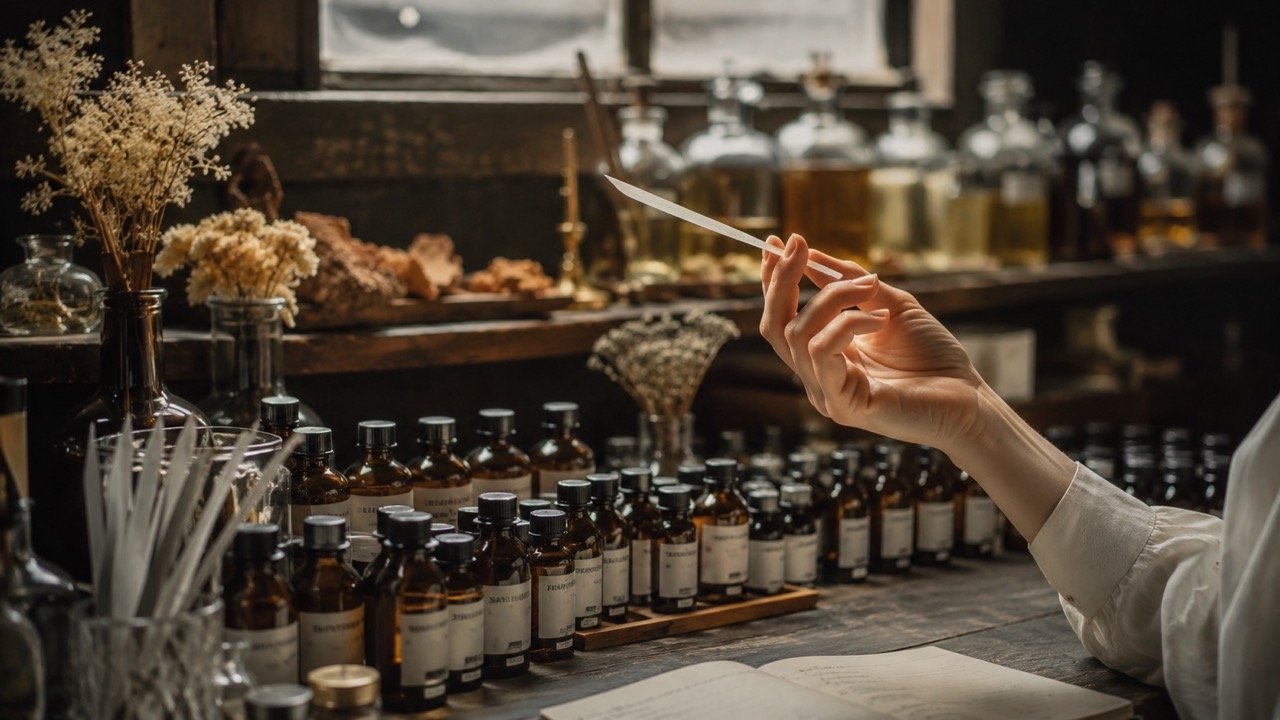
Fragrance is the most intimate of the luxury arts. It is worn on the body rather than carried beside it, perceived by others before a word is spoken, remembered long after the occasion has dissolved. A perfume can locate a decade, an afternoon, a particular person more precisely than any photograph. And yet the international fragrance market is dominated by an apparatus of celebrity attachment and mass production that reduces this intimate art to a marketing category.
The people working in Sydney in artisanal perfumery are operating in deliberate opposition to that apparatus. Their raw materials are botanicals, resins, and synthetics selected for quality rather than cost efficiency. Their production volumes are small enough that lot variation is a meaningful concept — bottle 47 of a particular batch may differ subtly from bottle 48, because the iris root used in the heart dried differently in that season. This is not a defect. It is a record of the material’s natural life.
Australian Notes: What Makes a Sydney Fragrance
The question of what a distinctly Australian fragrance smells like is not rhetorical — it has specific answers.
Lemon myrtle, native to Queensland’s subtropical rainforest, contains a higher concentration of citral than any other plant on earth. Its fragrance is lime and lemon stripped of all ambiguity — pure, bright, almost synthetic in its intensity, which is what makes it interesting in the hands of a skilled perfumer who can use it as a note rather than a statement.
Boronia, grown commercially in Tasmania, produces an absolute that smells of violet, raspberry, and something beyond both — warm, slightly medicinal, difficult to categorise. It is one of the most expensive raw materials in the perfumer’s kit, which is why it is almost never used in commercial fragrance.
Sandalwood from the Western Australian sandalwood tree (Santalum spicatum) carries a drier, cooler register than the Indian sandalwood that dominated classical European perfumery for centuries. It is the base note that anchors the most distinctive Australian fragrances to a specific landscape.
These materials, and others — wattle, paper bark, finger lime peel, sea spray from specific coastal headlands — constitute a vocabulary that the best Sydney and Australian perfumers are developing with genuine intentionality.
Aesop Aromatique, Various Sydney Locations
Aesop occupies an unusual position in this landscape: it is neither fully artisanal nor fully commercial. Its fragrance programme — developed in-house with the same ethos that governs the skincare range — uses materials of exceptional quality and produces compositions of genuine intelligence, while reaching a scale that the independent perfumers below cannot approach.
The Aesop Marrakech Intense, the Hwyl, and the Othertopias range sit comfortably in conversations with niche European fragrance houses. More to the point, the in-store consultation at any Sydney Aesop location is conducted with a seriousness — and a patience — that the international fragrance retail environment rarely provides. The staff are trained to understand the compositions, to explain the note evolution over time (important for complex fragrances that change significantly from application to dry-down), and to allow the customer to sit with a fragrance on skin for twenty minutes before making a decision.
Multiple Sydney locations. The Paddington and Surry Hills stores offer the most unhurried consultation environment. aesop.com
Goldfield & Banks, Available at Libertine Parfumerie
Goldfield & Banks is an Australian niche house producing fragrance with the materiality and compositional sophistication of the best European independents. Founded by Xavier Renard, the house uses a high percentage of naturals — boronia absolute, Australian sandalwood, Tasmanian boronia — and commissions compositions from both established and emerging perfumers.
The Silky Woods — Sandalum spicatum and Australian Boronia absolute with a cedar and ambrette seed base — is the house’s most compelling argument for what an Australian fine fragrance can be. It does not attempt to replicate a European style with local materials; it builds a composition that is legible only in the context of specific Australian landscapes.
Libertine Parfumerie in Melbourne stocks the full range and ships nationally; in Sydney, selected fragrances are available at Harrolds CBD. The bespoke consultation available through Goldfield & Banks direct allows clients to develop a personalised version of existing compositions with adjusted concentrations and modified notes.
Available at Harrolds, 142 Castlereagh Street, Sydney CBD, and online at goldfieldandbanks.com.au
Bespoke Commission: Ineke Fragrance (by International Sourcing)
For clients seeking a truly bespoke commission — a single fragrance developed specifically for and belonging to one person — the most accessible pathway in Australia involves working with a Sydney-based fragrance consultant who sources from international workshops with genuine bespoke capability.
The process, at this level, begins with a conversation about the client’s existing fragrance history: what they wear, what they have worn, what they respond to in other people, what memories are olfactorily significant. From this, a brief is developed and communicated to a trained perfumer (in France, Switzerland, or the UK, where the major independents with bespoke programmes operate).
The iteration process involves scent strips sent by post, phone consultations about what works and what does not, and a period of wearing the working composition before finalisation. The finished fragrance is produced in a bespoke concentration — typically a pure parfum — in a quantity sufficient for two to three years of daily use, with the formula held exclusively.
Cost is significant — genuine bespoke fragrance commission, from reputable workshops, begins at approximately $5,000 and rises with the quality of materials and the complexity of the brief.
For Sydney-based referrals to fragrance consultants working with international bespoke houses, enquire through Harrolds fragrance department or contact Libertine Parfumerie for their Australian consultant network.
On Wearing Fragrance Well
A brief guide, because the application of fragrance is as much a skill as the selection of it.
Apply to pulse points — wrists, inner elbows, neck, behind the knees — where body heat will warm the fragrance and aid diffusion. Do not rub the wrists together; rubbing breaks the molecular structure of the top notes. Apply to clean, moisturised skin; dry skin holds fragrance poorly.
Allow thirty minutes minimum between application and judgement. The top notes of almost any well-composed fragrance are its least interesting element — designed to capture attention and then recede. The heart and base notes, which take fifteen to thirty minutes to emerge, are where the perfumer’s work becomes visible.
Fragrance is not loud. The radius of appropriate projection in a business or social setting is arm’s length — perceivable by someone in close proximity, but not announced across a room. The goal is discovery rather than declaration.
Store fragrances away from light and heat — a dark, cool cabinet rather than a bathroom shelf. Heat and UV light break down the volatile compounds that constitute the fragrance’s character over time. The box the bottle came in, kept closed and away from the bathroom, is adequate storage for most collections.
Bespoke fragrance and niche perfumery are categories in rapid growth, and new Australian houses emerge regularly. This guide reflects the most established and reliable at time of writing; the landscape will evolve.