
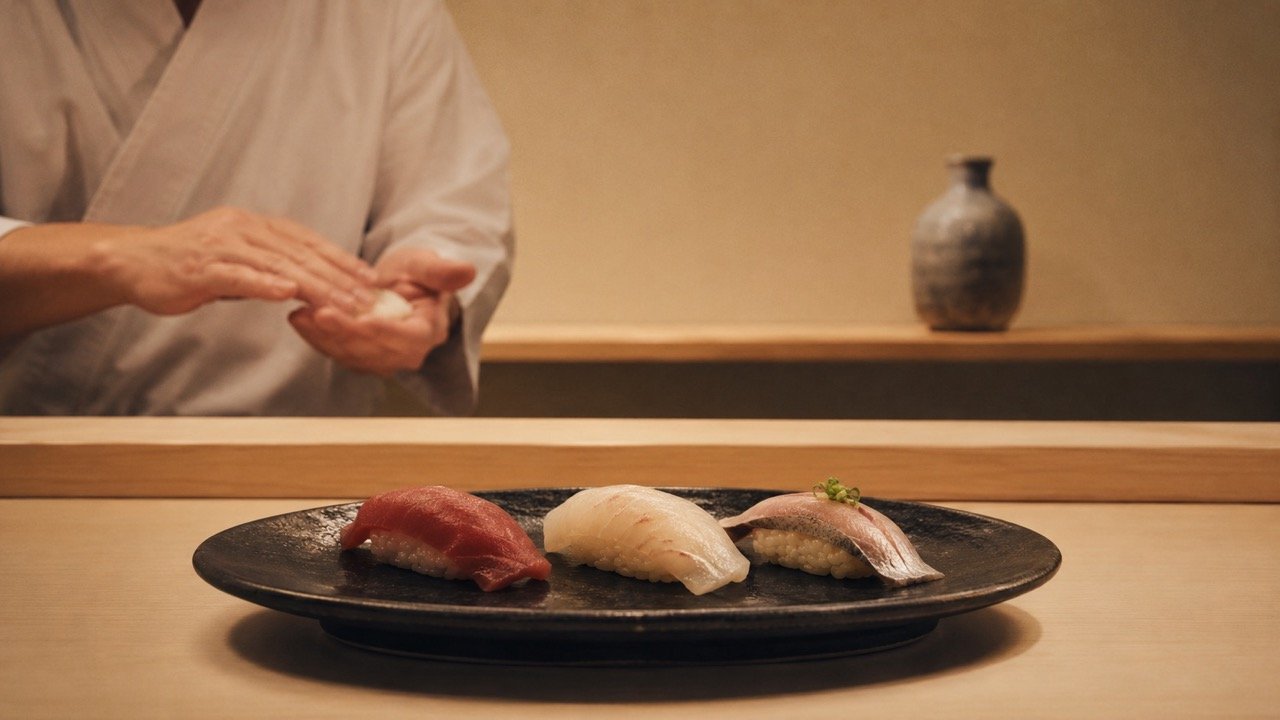
Omakase — literally "I leave it to you" — is one of the few dining formats in which the transaction is inverted. The guest does not choose. The chef chooses, courses unfold in sequence, and the only question is whether trust has been sufficiently established for the diner to receive rather than direct.
In Japan, this format has its own architecture: a counter of hinoki wood, eight to twelve seats, the chef visible at all times, rice seasoned with a particular ratio of rice vinegar, sugar, and salt that varies by region and is kept with the secrecy of a family recipe. In Sydney, a small number of rooms have replicated not the aesthetics but the spirit of this arrangement — the intimacy, the surrender, the singular focus of a kitchen producing one meal for the people in front of them.
A Note on Protocol
For those new to the format: the counter is not a restaurant with an omakase option. It is an omakase room that also functions as a restaurant. The difference is structural. Arriving on time matters — the kitchen times courses across all seats simultaneously, and a late arrival disrupts a sequence built for the room as a whole. Dietary restrictions should be communicated at reservation; the kitchen will accommodate genuine requirements without reducing the quality of the experience. Questions about the food are welcomed; in the best rooms, the chef considers them part of the service.
Kisumé Level 2, Melbourne — and Why Sydney Doesn’t Have Its Equal Yet
A moment of honesty: at the time of writing, Sydney does not have an omakase counter of the calibre available at Kisumé’s Level 2 in Melbourne, where chef Shinya Nakao produces twenty-course nigiri sequences that would hold their own in Kyoto. The gap between Sydney and Melbourne in this specific format remains real.
This is not, however, a reason to abandon the pursuit. What Sydney has is a cluster of rooms approaching the standard from different directions — some through supreme quality of fish, some through the rigour of their rice, some through the depth of their sake programmes — and the best of them are genuine experiences even against the international benchmark.
Shōryū, Surry Hills
Shōryū operates from a Surry Hills terrace with the particular quietness of a room that does not advertise itself. The counter seats eight. The omakase menu runs to eighteen courses of sushi and sashimi, constructed around whatever the kitchen considers most significant on any given day — this changes not by season but by the specific quality available at the morning market. If the Tasmanian sea urchin is exceptional, the urchin course expands; if the King George whiting from Western Australia is running clean and sweet, it appears twice in different preparations.
Chef Yusuke Morita trained in Osaka before moving to Sydney, and his rice — seasoned with Akashi rice vinegar and aged for three days after cooking — is the foundation on which everything else is built. The temperature at which the rice is served (body temperature, always, never fridge-cold) is not a detail. It is the most important decision made in an omakase kitchen.
The sake list at Shōryū is managed with the same precision as the food. The pairing menu — five sake courses aligned to the main omakase sequence — is the correct way to experience the room.
Surry Hills. Reservations essential — booking opens six weeks in advance. Counter seating only. Omakase from $220 per person.
Sokyo, The Star
Sokyo occupies a different register — it is a full-scale Japanese restaurant with a broad menu and a significant bar programme, not a dedicated omakase counter. But the sushi counter section of the room, bookable separately from the main dining floor, functions with the focused attention of the omakase format and delivers a quality of fish handling that is among the most consistent in the city.
Executive chef Chase Kojima has spent years developing the supplier relationships that the counter requires — direct sourcing from specific Tasmanian and South Australian fishing operations, relationships with Japanese importers that allow access to products (specific tuna cuts, aged miso, particular grades of uni) that don’t reach the general market. The result is a counter where the quality of the raw material is essentially beyond question.
The full omakase at Sokyo runs to twenty-two courses. The sake list — managed by a team that treats it as seriously as any wine programme — is among the deepest Japanese sake selections in Australia.
The Star, Pyrmont. Omakase sittings at 6pm and 8:30pm. Reservations essential. From $280 per person for the full counter omakase. sokyo.com.au
Fujisaki, Barangaroo
Fujisaki arrived in Barangaroo’s waterfront precinct with the backing of a significant hospitality group but the sensibility of a smaller, more focused room than its setting might suggest. The omakase programme — offered at the dedicated counter within the larger restaurant — is managed by a kitchen whose sashimi and nigiri preparation follows protocols that the mainstream restaurant market rarely insists upon: the fish is sliced against the grain at a specific angle for each species, the rice grain remains distinct rather than compressed, the wasabi is freshly grated rather than reconstituted.
The Barangaroo location provides harbour views that shift through the omakase sequence as the light changes — the room faces west, and a 6pm sitting in summer produces a sunset through the full-height glass that is, by the account of everyone who has sat through it, genuinely extraordinary. The courses continue after dark with no change in quality; the ambience simply becomes something else.
International Towers, Barangaroo. Counter omakase bookings separate from main restaurant. From $195 per person. fujisaki.com.au
On Rice
A brief argument for paying attention to the rice, because it is what distinguishes the counters above from the many restaurants that use the word omakase loosely.
Sushi rice — shari — is made from short-grain Japanese rice cooked with a specific volume of water, seasoned with a mixture of rice vinegar, sugar, and salt at precise ratios developed by each chef over years, then cooled to body temperature before use. The seasoning is called awasezu and its composition is, in serious kitchens, not shared with anyone outside the kitchen.
The rice should hold its shape when pressed but dissolve on the tongue without stickiness. The temperature, as noted, should be body temperature — the same temperature as the fish above it. A piece of sushi served cold (from refrigeration) has committed the fundamental error before a single flavour decision has been made.
At the best omakase counters, the rice is as important as the fish. Ask the chef about their shari — any serious practitioner will find the question natural and the answer genuine.