
The standard Blue Mountains weekend begins at Echo Point and ends with a scone at the Hydro Majestic. This guide is not about that weekend.
The mountains — the escarpment that begins an hour west of Sydney and drops seven hundred metres to the Jamison Valley below — contain within their two million hectares of World Heritage wilderness a different kind of experience entirely: small-batch winemakers whose cellar doors open only to those who call ahead, architect-designed cabins that sit in the forest with the quiet confidence of buildings that have earned their setting, restaurants in converted railway buildings that cook with the produce of the ridge above and the valley below, and a quality of silence, particularly in the upper mountains above Leura and Blackheath, that is one of the rarest things available within two hours of a major city.
Where to Stay
### Escarpment Retreat, Leura
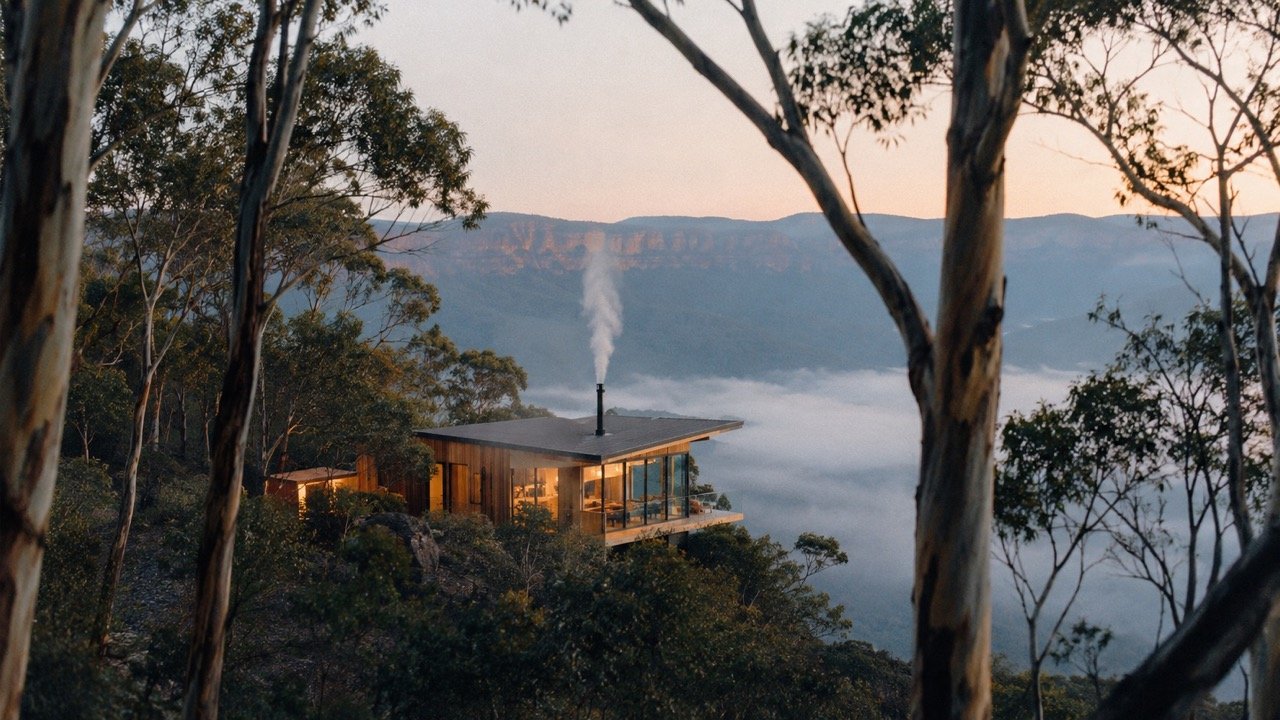
The name suggests a resort. The reality is more interesting. Escarpment is a collection of individual pavilions — five standalone structures, each separated from the others by enough forest to produce the illusion of genuine seclusion — designed with a restraint that takes the escarpment landscape seriously. The architecture reads as a conversation between the angular demands of modernist pavilion design and the organic reality of the gum trees that surround it: large glass walls, raked timber ceilings, concrete and stone that acquire their character from the forest they contain.
Each pavilion has its own private deck and private plunge pool — the pool is heated, which matters at elevations that produce cool nights even in summer. The interiors are furnished with the considered sparseness of spaces that have thought carefully about what a weekend in the mountains actually requires: a good bed, a kitchen worth using, a fireplace, and an absence of the ambient busyness that constitutes most contemporary living.
The staff arrange everything available in the mountains within an hour’s radius — cellar door bookings, restaurant reservations, guided bushwalks with naturalists who know the difference between the valley’s bird species well enough to make you feel it. None of this is obligatory; the retreat functions equally well as a space for doing nothing.
Leura. Rate on enquiry. escarpmentretreat.com.au
### DUET Blackheath, Blackheath
DUET is two adjacent private cabins in Blackheath, bookable individually or together, designed by a small Sydney architecture practice with a specific brief: create spaces that defer to the landscape rather than compete with it. The result is a pair of timber-and-glass structures that seem, from a distance, to be part of the forest — low, horizontal, with roof planes that follow the angle of the escarpment above.
Interiors are exceptional for their specificity: the kitchen is stocked with provisions from local producers (Blue Mountains honey, Megalong Valley lamb, eggs from a farm twenty minutes south) as part of the arrival. The library — a small collection of relevant books assembled for the retreat rather than inherited from a supplier — runs to architecture, Australian natural history, and Australian literature. The bath is the correct size.
Blackheath sits above the valley at a higher elevation than Katoomba and Leura, which means colder winters, less tourist traffic, and more genuine quiet. In the morning — particularly in winter — the mist from the Grose Valley below rises to the level of the escarpment and the forest above the cloud for approximately an hour before the sun dissolves it.
Blackheath. Two-night minimum. Enquiries via duetblackheath.com.au
The Cellar Doors
### Cobbitty Wines, Megalong Valley
The Megalong Valley descends from the Blackheath plateau via a single switchback road that most visitors to the area drive to the bottom of and return without knowing what they missed. What they missed includes Cobbitty Wines: a small family operation farming two hectares of Pinot Gris and Riesling on a south-facing slope at seven hundred metres elevation, producing perhaps eight hundred cases a year and distributing almost none of it below the mountains.
The cellar door is a converted dairy — cold stone, original timber ceiling, a view across the valley to the cliffs of the escarpment. Tastings are by appointment only and conducted by the family; the conversation is about the vineyard, the vintage, the particular challenges of farming at altitude without the warming influence of the valley floor. There is no commercial pressure. There is very good wine.
Reserve the 2022 Riesling if it is still available. It is the best expression of altitude Riesling produced in the greater Sydney region.
Megalong Valley Road, Megalong Valley. By appointment only — call ahead.
### Rosenthal Wines, Blackheath
Rosenthal operates from a converted mid-century property on the outskirts of Blackheath, the cellar door occupying a studio space that was previously used for glassblowing. The wines — Pinot Noir and a small-volume orange wine made from Hunter Valley Semillon — are produced with the kind of deliberate restraint that characterises the natural wine movement at its most serious.
The tastings here have the character of a conversation about winemaking philosophy rather than a tour through a list. The founders are interested in questions about intervention, about what the land expresses when the winemaker resists the urge to correct it, and they communicate this interest with the specificity of people who have spent considerable time thinking about it.
The orange wine in particular — amber, tannic, alive in the glass — is worth the drive independently of anything else in the mountains.
By appointment. Blackheath — address provided at booking.
Where to Eat
### Silks Brasserie, Leura
Silks occupies a Victorian terrace on Leura Mall with the confidence of a restaurant that has been making the same argument about regional produce for long enough to have been proved right. The cooking is Modern Australian in the most genuine sense — using the exceptional ingredients available within a short radius of the restaurant (Megalong Valley lamb, Blue Mountains honey, local trout) with the technique required to let them be themselves.
The wine list is predominantly local — Hunter Valley, Orange, and the small Blue Mountains producers — with depth in older vintages of Hunter Semillon that reads as a genuine curatorial statement. A bottle of aged Tyrrell’s Stevens Vineyard Semillon alongside the slow-roasted lamb shoulder is one of the most satisfying combinations available in the greater Sydney region.
Book a window table on the eastern side for the late-afternoon light across the Leura shopping street, which achieves a particular golden-hour quality that makes the heritage buildings look precisely as they should.
128 The Mall, Leura. Lunch and dinner Thursday to Monday. silksbrasserie.com.au
### Darley’s Restaurant, Lilianfels
Darley’s — in the heritage-listed Lilianfels estate at the escarpment edge above Echo Point — is the mountains’ most formally ambitious restaurant, and it warrants that ambition. The room is a converted Victorian house, the cooking is degustation-length and technically exacting, and the setting — the escarpment drops away 300 metres below the terrace — provides a scale that no interior could replicate.
The menu changes with the seasons, but the kitchen’s relationship with game, with the cooler-climate produce of the mountains region, and with the native botanicals that the escarpment provides, gives the food a specificity that distinguishes it from the hotel restaurants that have similar aspirations and less interesting landscapes.
Reserve at least two weeks in advance for weekend sittings. The drive to Echo Point after dinner, in the dark, with the valley invisible below and the stars overhead, is worth the detour.
5 Lilianfels Avenue, Katoomba. Dinner Thursday to Sunday. liliianfels.com.au
The Walk That Changes the Weekend
The Six Foot Track — a 45-kilometre route from Katoomba to Jenolan Caves — is too long for a standard weekend. But the first eight kilometres, from Explorers Tree at Katoomba to the valley floor at the Megalong Village, descend through the kind of wilderness that recalibrates the nervous system within the first thirty minutes.
The track name comes from its origins as a cleared path wide enough for two horses to pass — six feet — and sections of the original clearing survive along the route through open forest. The descent to the valley, through blackbutt and blue gum, passes perspectives across the Megalong Valley that appear on no postcard and in no standard tour itinerary.
Return by the same track or arrange transport from the valley floor. The descent takes approximately three hours; the return ascent, two and a half.
Blue Mountains accommodation books well in advance for winter weekends, when the cold weather and leaf colour produce peak demand. Cellar doors operate variable hours and seasons — confirm by phone before visiting. Road access to the Megalong Valley may be restricted after heavy rain.