
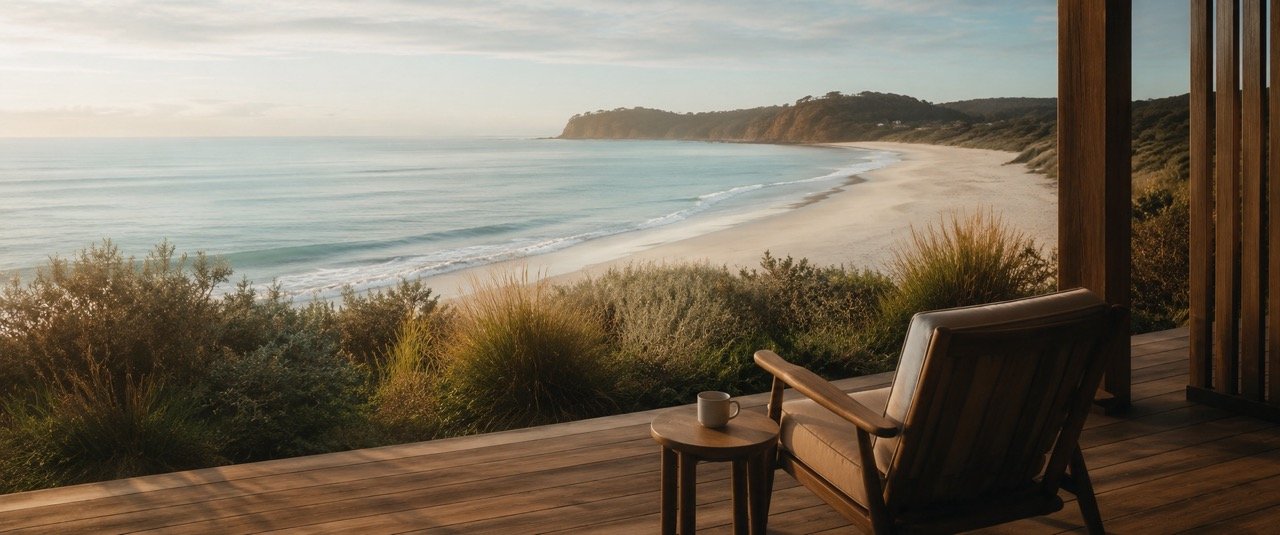
The Byron Bay story has been told so many times, from so many angles, for so many categories of visitor, that it has ceased to describe anything useful about the actual experience of being in the Northern Rivers. The serious traveller arriving in this region in 2025 is not going to Byron Bay in the way that phrase is commonly understood — the main beach, the lighthouse walk, the famous restaurant that has been reviewed a hundred times and will be reviewed a hundred times more. They are going to the version of this region that preceded the celebrity-resort period and that persists alongside it: the hinterland villages with genuine character, the estuaries that have not been photographed into abstraction, the food producers whose work is exceptional and whose names are known to the city’s best chefs but not yet to their customers.
The Northern Rivers hinterland — the fertile volcanic country inland from Byron, centred on Bangalow and extending north through Brooklet and south toward Newrybar — is this version. It is also, not incidentally, more beautiful than the beach strip: the rolling green hills, the macadamia orchards, the ancient basalt country with its deep soil and its specific morning mist, are the landscape that serious travellers come back to, year after year, when Byron Bay itself has become noise.
Where to Stay: Hinterland House, Bangalow
One minute from the centre of Bangalow village and ten minutes from Byron Bay, Hinterland House is a heritage-listed 1906 homestead set among twenty acres of macadamia orchard and formally maintained gardens. The eight-bedroom estate — the original homestead plus adjunct cottages that can be configured for smaller or larger parties — has been managed since its inclusion in the Spicers Collection with the kind of considered service that the property’s bones deserve.
The specific pleasure of Hinterland House is the combination of historic grandeur and functional luxury: the wrap-around verandas with their views over the orchard toward the hinterland ridgeline, the pool and fire pit for the hours between afternoon activity and dinner, the sense of having arrived somewhere with its own internal logic rather than a hotel that could be anywhere. The 30-metre timber deck works as the default setting for the afternoon: a glass of something cool, the macadamia trees in their rows, the light changing over the hills.
The location makes the estate genuinely useful as a base. Bangalow village is walkable; Brunswick Heads is twenty minutes; Byron Bay proper is accessible for those who want it, but not so close that its particular energy intrudes.
Hinterland House, Bangalow. hinterlandhouse.com.au
Bangalow: The Village as Destination
Bangalow village occupies a heritage streetscape on the Byron hinterland escarpment — wide main street, established trees, a particular combination of local permanence and culinary seriousness that distinguishes it from both the tourist strip and the rural hinterland proper. The Saturday market is the weekly convergence of the region’s food producers, but the village’s character is not dependent on market day; it holds its quality through the week.
The dining conversation in Bangalow has become, in recent years, genuinely serious. You Beauty, the no-waste bistro run by chef Matt Stone — whose food philosophy of whole-animal cooking and zero-waste practice informed some of the most interesting restaurant work in Australia over the past decade — operates from the village with the ease of a cook who has found the right scale for what he wants to do. The menu moves with the farm’s production and the season; the cooking reflects intelligence rather than ambition, which at this stage in the chef’s career is a distinction with a real difference.
Zentveld’s Coffee Farm, a few kilometres from the village centre, is the regional reference point for coffee that has been grown, roasted, and served within the same agricultural landscape. The Northern Rivers is the southernmost commercial coffee-growing region in Australia, and Zentveld’s has been producing quality arabica here since 1993. The farm café is not a destination in the performative sense; it is simply good coffee in a context that makes the provenance self-evident.
Brunswick Heads: The Correct Estuary
Brunswick Heads is what Byron Bay would have been if the fame had landed elsewhere. A small coastal town at the mouth of the Brunswick River, twenty minutes north of Byron, it has a main street that is perhaps two blocks long, a calm estuary ideal for morning kayaking, a surf beach that is both reliable and un-crowded, and an increasingly serious food culture that is arriving organically rather than by developer design.
The most significant recent addition to the Brunswick Heads dining scene is The Ducks at Hotel Brunswick — the partnership between Three Blue Ducks and the historic Hotel Brunswick pub that opened in late 2024. Co-directed by Darren Robertson and Andy Allen, with head chef Loki Lynch managing the day-to-day kitchen, the pub programme draws on Northern Rivers produce with a directness that the Three Blue Ducks model has always advocated: local bay lobster, king prawns, woodfired pizza, the kind of elevated pub cooking that Sydney’s best venues attempt and regional Australia rarely achieves. The beer garden, with its views over the Brunswick River, is among the more pleasant places to spend a long lunch in this part of the world.
The Sails Motel on Tweed Street — a renovated mid-century motel with 22 rooms, a pool, and access to the beach and river on foot — is the correct low-intervention accommodation choice for the Brunswick Heads visit. It does not pretend to be a luxury hotel; it is a well-run motel in a town that does not need or want luxury hotel theatrics.
Hotel Brunswick / The Ducks at Hotel Brunswick, Brunswick Heads. threeblueducks.com/brunswick The Sails Motel, 26–28 Tweed Street, Brunswick Heads. thesailsmotel.com.au
The Macadamia Country
The macadamia is native to the subtropical rainforests of northern New South Wales — specifically the country of the Bundjalung and Yaegl peoples, among others, who ate the nuts for thousands of years before the European industry named and commercialised them. The first commercial orchard was planted in Lismore in the 1880s, and the Northern Rivers — the fertile volcanic country between Ballina, Lismore, and Bangalow — was, until recently, the largest macadamia growing region in Australia.
Brookfarm, which began when Pam and Martin Brook bought a rundown dairy farm in the Byron hinterland in 1989 and planted more than 4,000 macadamia trees, is the producer that has done more than any other to elevate the macadamia from commodity nut to considered ingredient. The farm operation also includes significant regeneration work — 35,000 rainforest and eucalypt trees replanted — that reflects the kind of agricultural philosophy that the Northern Rivers food culture at its best represents.
Duck Creek Macadamias, farming from the Newrybar and Teven properties since 1987, represents the multi-generational farming dimension of the region: the families for whom the macadamia orchard is not a lifestyle statement but a serious agricultural inheritance. The nuts available directly from farms of this calibre — harvested to order, not stored indefinitely — are a materially different thing from what appears on the supermarket shelf.
On Getting There
The drive from Sydney to the Byron hinterland runs to approximately ten hours by car, following the Pacific Highway north through the Hunter, across the Manning River valley, and up the coast past Port Macquarie and Coffs Harbour before turning inland toward Bangalow. This is not a scenic drive in the conventional sense — large sections of the Pacific Highway are dual carriageway through unremarkable coast hinterland — but the final hour, as the road climbs into the volcanic country north of Lismore and the macadamia orchards begin to appear in the paddocks, announces the arrival of a different landscape with appropriate drama.
The alternative is the one-hour flight from Sydney to Ballina Byron Gateway Airport, which delivers the traveller to a small regional airport twenty minutes from both Bangalow and Brunswick Heads. For the weekend visit without a planned driving itinerary, this is the rational choice. The car hire at Ballina is the first purchase; the second is the coffee at Zentveld’s.
The correct length of stay is three nights, which allows one full day in the hinterland and one oriented toward the coast and estuary, with the first and last afternoons for arrival and departure. Two nights is possible but leaves insufficient time to absorb the pace that is the region’s primary offering.