
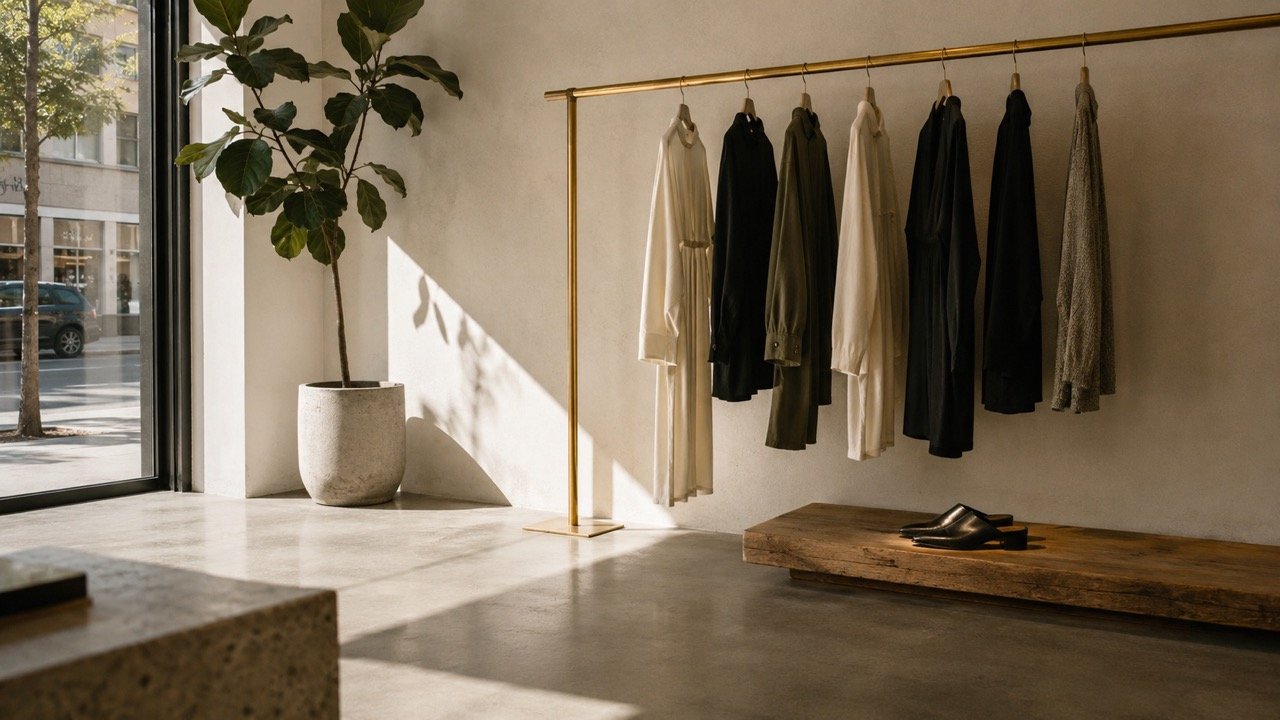
Sydney dresses for the aperitivo; Melbourne dresses for the argument. This is not a provocation — it is a structural observation about two cities whose fashion cultures have always diverged more sharply than their physical distance would suggest. Melbourne’s specific sartorial intelligence — dark, layered, considered, with a preference for cut and fibre quality over logo and occasion — has more in common with Tokyo’s independent fashion culture and Copenhagen’s restrained pragmatism than it does with Sydney’s Mediterranean brightness. The city’s European immigration history gave it a continental attitude toward dress as a daily and disciplined practice. Its climate — variable in a single afternoon, never definitively warm — produced a wardrobe that prizes layering and all-season wool. Its creative community — musicians, writers, gallerists, academics, architects — produced a culture in which the way you dress is continuous with the way you think, not separate from it.
The result is a fashion geography that you can read as a kind of argument unfolding across the inner suburbs. It begins in the Brotherhood of Saint Laurence op shops and the warehouse floors of Lost and Found Market in Fitzroy, moves through Gorman’s wearable-print intelligence and Alpha60’s monochromatic rigour, and reaches its most rarefied form in the bespoke ateliers of South Melbourne and the CBD. At every price point, the underlying logic is the same: clothing as something chosen with attention, rather than consumed.
What distinguishes Melbourne’s fashion culture from mere style consciousness is the quality of knowledge it produces. A Melburnian who has been buying thoughtfully here for a decade knows the difference between a block-fused and a canvas chest, between a natural-shoulder cut and a structured one, between a linen-cotton that will pill and one that will improve with washing. This knowledge is acquired partly through the accumulation of excellent objects and partly through the particular intimacy that Melbourne’s independent fashion community makes possible — the designer who explains why she chose a Japanese chambray over a domestic cotton, the tailor who shows you the horsehair canvas before he closes the chest. Elsewhere, fashion is about acquisition. Here, it is about understanding.
Alpha60: The Monochromatic Argument
Alpha60 — launched in 2005 by siblings Georgie and Alex Cleary, its name drawn from Godard’s Alphaville — is the closest Melbourne has to a house signature: monochromatic, architecturally cut, informed by the Japanese designers of the 1980s without being derivative of them. The Clearys’ intelligence is in the translation: they take the radical simplification of Kawakubo and Yamamoto’s generation and render it wearable for a city that shares the aesthetic premise but not the performance context. An Alpha60 garment — a wide-leg trouser in heavy cotton, a jacket with unusual seam placement, a knit that reads as sculpture before it reads as clothing — makes a claim about the body without demanding that the wearer disappear into the claim.
The label operates from its creative hub in Collingwood, with stores across Flinders Lane, Armadale, and Prahran. What distinguishes it from similar-looking international labels is locality: the production relationship with Australian makers and the direct connection between the design studio and the shop floor means that the people selling the clothes understand them in the same terms the designers do. You can ask why a specific pocket placement works this way, and the answer will be architectural, not commercial. This is unusual in fashion retail at any level, and it is a Melbourne quality.
Multiple Melbourne locations; flagship at Flinders Lane. alpha60.com.au
Gorman: Seriousness in Colour
That Gorman — founded in Fitzroy in 1999 by Lisa Gorman as a boutique with an initial collection titled ‘less than 12 degrees’ — belongs in a conversation about serious Melbourne dressing is itself a position worth defending. The label’s signature is print: bold, artist-collaborative, emphatically not neutral. But the seriousness is structural, not decorative. Gorman’s collaborations with visual artists — translating paintings and graphic works into wearable editions — treat clothing as a medium for image rather than as a background for personality. The result is work that sits differently to fast fashion and differently to conventional luxury: it is produced with care for fibre and construction, at a price point that reflects actual manufacturing cost, and designed with the understanding that a print garment makes a claim on the world that a black turtleneck politely declines to make.
The brand now has more than forty stores nationally, which is large for an Australian label, but the Fitzroy original retains the atmosphere of its founding: a boutique where the politics of making are as present as the clothes themselves. The label’s commitment to organic and recycled fabrics is not greenwashing — it is the consistent extension of a founding position. Melbourne’s fashion community understands the difference.
Fitzroy flagship at 252 Smith Street. gormanshop.com.au
Lost and Found Market: The Vintage Economy
The enormous heritage warehouse at 288 Brunswick Street, Fitzroy — upstairs, through a door that gives nothing away from the street — houses 900 square metres of what Melbourne’s vintage economy produces when it functions at its most serious. Lost and Found Market is not a costume shop or a nostalgia retail. It is a buying environment for people who understand that a 1980s Japanese cotton shirt, a 1970s Italian wool blazer, or a Victorian cotton tea gown has qualities — of construction, of material, of proportion — that contemporary production at the same price point cannot match.
The stock is curated in the way that a good dealer curates: with an eye for condition, for rarity, for the object that will read correctly in a contemporary wardrobe rather than merely reading as vintage. Fashion buyers from Melbourne’s independent labels shop here, as do stylists, as do architects who understand that the relationship between old buildings and old clothing is not accidental. The market also carries furniture, vinyl, and books — it is the kind of space that reveals the buyer’s range of interest rather than flattering any single taste. Come here knowing what you are looking for but willing to be interrupted by what you were not.
Upstairs, 288 Brunswick Street, Fitzroy. lostandfoundmarket.com.au
The Brotherhood of Saint Laurence: The Serious Op Shop
The Brotherhood of Saint Laurence, established in the 1930s, operates op shops across Melbourne with a particular quality of donated stock that reflects the city’s wardrobe culture — which is to say, periodically, something exceptional appears on a BSL rack. Melbourne has always had a class of dressor who, when clearing an estate or a wardrobe, donates to BSL rather than selling piecemeal. This produces, unpredictably but genuinely, the appearance of Comme des Garçons pieces, Akira Isogawa garments, and serious vintage tailoring at op-shop prices, accessible to anyone who has the patience and the knowledge to recognise what they are looking at.
Hunter Gatherer, a BSL-affiliated store that handpicks from the op-shop network across Victoria, distils this to a more reliable experience — it is a curated BSL edit, which removes the luck factor at the cost of some of the archaeology. Both approaches have merit. The full op-shop experience rewards frequency and the trained eye; Hunter Gatherer rewards the buyer who wants the BSL quality of stock without the Tuesday-morning treasure hunt. Either way, the underlying resource is the same: Melbourne wardrobes, accumulated across decades of serious dressing.
BSL op shops across Melbourne; Hunter Gatherer at 246 Brunswick Street, Fitzroy.
The Protocol of Dressing Here
Melbourne’s fashion geography is best navigated in person, not online — the textures, fits, and proportions that distinguish excellent from merely acceptable are lost in product photography. The Flinders Lane strip remains the most concentrated address for independent womenswear; Smith Street, Collingwood, for independent labels across all categories; High Street, Armadale, for a mix of Australian designers and serious vintage. The Nicholas Building’s upper floors — see the deep-dive for details — add jewellery and textile art to the wardrobe conversation.
The insider protocol: avoid the obvious Chapel Street boutiques, which represent Melbourne’s most commercial retail rather than its most interesting. The ratio of knowledge to square footage is reliably inverse — the smaller the room, the more the person behind the counter knows, and the more that knowledge is available to you if you ask a considered question. Ask about fabric composition, not care instructions. Ask where something is made, and why that specific construction was chosen. The answer tells you more about whether to buy it than any other available information.