
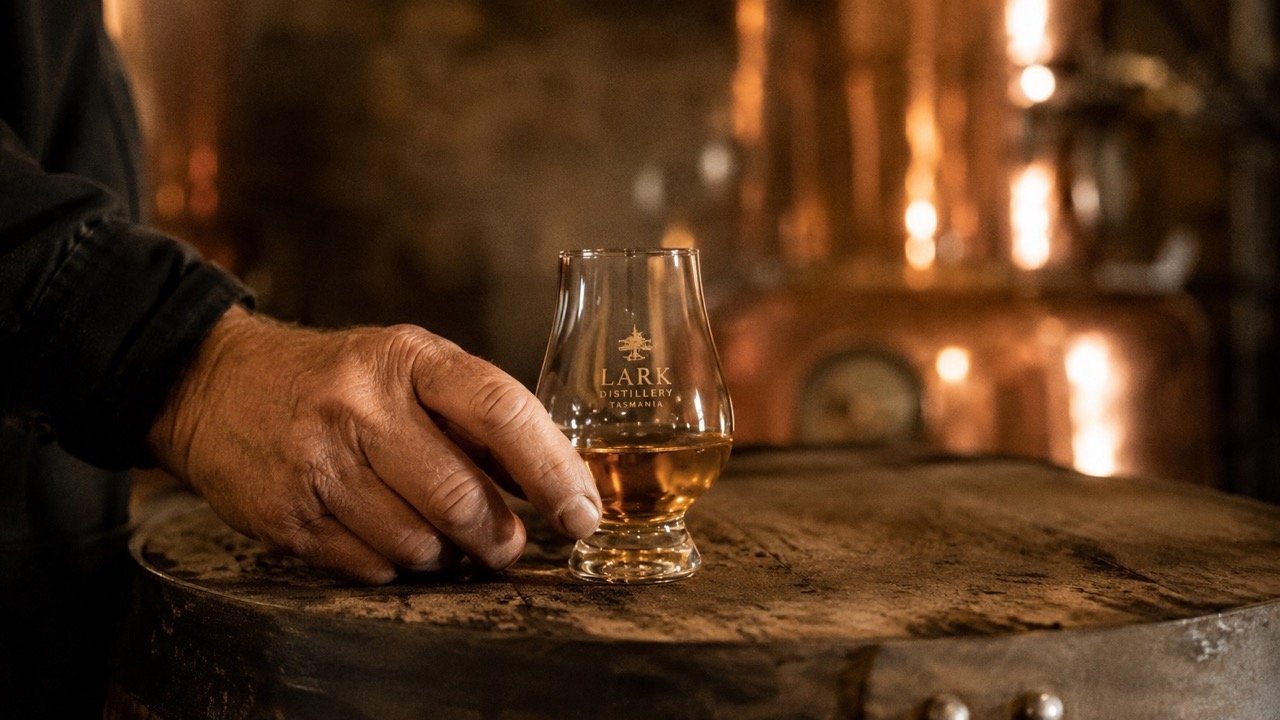
The argument for Australian whisky has always been environmental. Not the malted barley, which is not radically different from what you would find in Scotland; not the distillation equipment, which most serious Australian producers have acquired from established European or American manufacturers; but the climate, which is decisively, productively different. Australia’s temperature extremes — particularly in Victoria, where the contrast between a January afternoon and an August morning can exceed forty degrees — cause the spirit to expand and contract within the barrel at a rate that has no equivalent in Scotland or Kentucky. The result is faster extraction of flavour and colour compounds from the wood, and whisky that reaches maturity in four to six years rather than twelve. This is not a shortcut. It is a different mechanism of maturation producing a different kind of spirit.
The wine-country intersection is the distinctly Victorian contribution to this argument. Victoria is home to the Yarra Valley, the Mornington Peninsula, the Grampians, and the King Valley — cool-climate wine regions producing Chardonnay, Pinot Noir, Shiraz, and Muscat in barrels that, when the whisky maturation programme reaches for them, carry a flavour ghost of the wine that lived in them before. This is not merely an aesthetic choice. The oak’s interaction with the wine changes its cellular structure, leaving tannins and phenolic compounds in the wood that the maturing spirit then extracts alongside the oak’s own contribution. A barrel that held Yarra Valley Pinot Noir for three years does not smell like Pinot Noir — but the spirit it subsequently matures will carry something of that conversation. This is the core of Victorian whisky’s distinctiveness.
The Bunurong Boon Wurrung and Wadawurrung peoples’ Country encompasses much of the Victorian coastal landscape in which this whisky culture operates — from Port Phillip Bay to the Otways, from the Mornington Peninsula to the ranges. The spirits being produced in these locations are very recent tenants of an ancient and carefully managed Country.
Starward
David Vitale founded Starward in 2007 in Port Melbourne, three kilometres from the CBD, and has built it into Australia’s most internationally recognised whisky brand without sacrificing the specificity that made it interesting in the first place. The decision to mature all Starward expressions in Australian wine barrels — sourced from the Barossa Valley, the Yarra Valley, and McLaren Vale — was not commercially obvious when it was made. It has become the defining characteristic of the Starward portfolio and the clearest illustration of the wine-country barrel argument.
The Nova expression, Starward’s flagship, is matured entirely in Australian red wine barrels. The result is a single malt with a colour depth and sweetness that Scottish producers achieve only after fifteen or more years in European oak; Nova reaches this register at three to four years, the Melbourne climate doing in seasons what Scottish maritime cool does in decades. The flavour profile — dark fruit, vanilla, a wine-derived tannin structure — is unlike any Scotch and unlike any bourbon, which is precisely the point. Starward is not trying to be either.
The Port Melbourne distillery and bar is open to visitors and operates with an engagement with the production process that is worth more than the tasting alone. The barrel warehouse is temperature-variable in the way the spirit requires — warm in summer, cold in winter — and the visual effect of a thousand barrels in a working distillery, with the smell of spirit loss from the wood (the “angel’s share,” accelerated dramatically by the Melbourne climate), is one of the city’s more unexpected sensory experiences.
50 Bertie St, Port Melbourne. starward.com.au
Bass & Flinders Distillery
At Dromana on the Mornington Peninsula, Bass & Flinders has operated since 2009 as the first distillery on the peninsula and, in many ways, the clearest expression of the wine-country spirit logic. Where Starward draws on Barossa and Yarra Valley red wine barrels, Bass & Flinders takes the wine-country connection to its most complete form: they make their own grape-based eau de vie — distilled from Victorian wine purchased specifically for the purpose — which forms the base spirit for their entire range of brandies and gins. This is not sourced neutral spirit; it is made on-site from Victoria’s own wine culture, double-distilled in an alembic pot still, and then aged or flavoured according to the specific product.
The Ochre brandy — made from double-distilled Chardonnay, aged in French oak for five years — is the flagship that makes the clearest case for what Australian brandy can be when the wine-country intersection is pursued with genuine commitment. The flavour is European in lineage — aged French brandy is the obvious reference point — but the Peninsula Chardonnay from which it is distilled gives it a specific character: a freshness and lightness that separates it from Cognac or Armagnac without pretending to be something else. This is an Australian spirit that knows what it is.
The Distillery Door at Collins Road, Dromana, operates Friday through Sunday and can be combined naturally with the Peninsula wine and dining circuit described elsewhere in this magazine. A tasting at Bass & Flinders before lunch at Ten Minutes by Tractor is the most natural single-day itinerary on the Mornington Peninsula.
40 Collins Rd, Dromana. bassandflindersdistillery.com
The Aged Expressions and the Cellar Programme
The most serious engagement with Victorian whisky involves cellaring — buying expressions with the intention of watching them develop over years rather than opening them immediately. Both Starward and the broader Australian whisky category have produced limited vintage releases and cask-strength expressions that reward this patient approach.
Starward’s Two-Fold double grain whisky — made from wheat and malted barley, matured in Australian wine barrels — is the accessible expression that introduces the wine-barrel argument to new drinkers. The Octave expressions, matured in smaller forty-litre octave casks for accelerated development, are the collector’s items: produced in limited batches, with pronounced wood character and a concentration that the standard expressions do not seek.
The Australian whisky category has expanded significantly in the past decade, with producers in the Macedon Ranges, the Pyrenees, and the King Valley all making serious claims on the Victorian spirit conversation. The common thread is always the climate and the local barrel programme. In each case, the wine-growing geography that surrounds the distillery is not a coincidence — it is the supply chain and the maturation logic simultaneously.
On Drinking Victorian Whisky Seriously
The barrel matters more than the age statement. A five-year Victorian whisky in a former Yarra Valley Pinot Noir barrel will outperform a twelve-year Scotch in a tired bourbon barrel at the same price point. Ask about the barrel provenance before you commit to a bottle.
Neat, room temperature, a few drops of water. The wine-barrel character opens with dilution in a way that the more intensely oak-driven Scotch expressions do not. Add water incrementally and taste at each stage.
The distillery visit as education. Both Starward in Port Melbourne and Bass & Flinders in Dromana offer genuine transparency about their production process. The distillery experience converts the bottle from product to argument.
Buy the limited releases. Both Starward and Bass & Flinders produce limited-run expressions that are not available in retail. The mailing list is the way to access these; both operations maintain active subscriber programmes.
The comparison exercise. Set up a tasting that runs Nova (Starward, red wine barrel) beside an equivalent-age Scotch single malt and a small American craft whiskey. The Victorian wine-barrel character becomes unmistakably distinct, and not in an inferior way — in its own register, which is the whole point.