
The southernmost point of mainland Australia is a granite headland at the tip of Wilson’s Promontory that juts into Bass Strait at 39 degrees south latitude. Antarctica is 2,500 kilometres beyond it. The Southern Ocean that lies between — the roughest ocean on the planet, circling the continent unimpeded — produces weather systems that move northeast and break against this particular piece of granitic coast with the full force of water that has had nothing to stop it. To stand at South Point in a westerly and feel that wind — cold, horizontal, carrying sea spray from waves that began forming somewhere near Heard Island — is to understand, in a physical rather than intellectual way, what it means to be at the bottom of the country.
Wilson’s Promontory National Park encompasses 50,500 hectares of the peninsula that reaches south from South Gippsland, and it contains every Victorian coastal ecosystem in compressed form: coastal heath, granitic outcrops, dense coastal scrub, wetlands, estuaries, open forest, and beaches of such clarity and emptiness that they operate as a counterargument to every managed recreation area within three hours of the city. The park has been protected since 1905. It feels like it.
Squeaky Beach and the Tidal River
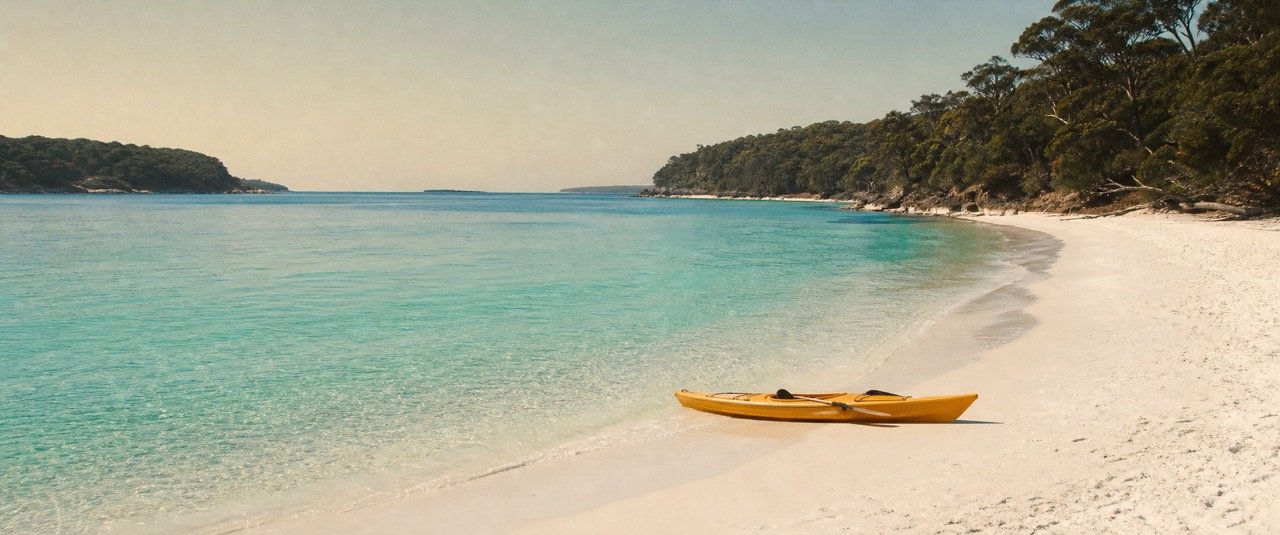
The quartz sand at Squeaky Beach — 15 minutes’ walk from the Tidal River settlement through coastal scrub — squeaks underfoot because the rounded grains of pure white quartz compress against each other as you walk. This is not a metaphor for anything. It is a geological fact: the quartz at this beach has been ground by wave action over millennia to a uniformity that produces the acoustic quality. The sound is real, the sand is the colour of milk, and the water in the curved bay between two granite headlands is a shade of aquamarine produced by the depth and clarity of the water over that white sand that is, in a temperate Australian context, entirely unexpected.
Tidal River, the settlement at the end of the park road that provides the accommodation and visitor services, sits at the mouth of the Tidal River where it crosses Norman Beach. The river is tidal — it backs up with the bay tide and runs out into the sea at low water — and the estuarine zone around the mouth produces excellent birdwatching: royal spoonbills, herons, black swans, and the wombats that graze the campground at dusk with a confidence that suggests a long history of negotiations about personal space going in their favour. The Parks Victoria huts at Tidal River — basic single-room structures with cooking facilities and access to campground amenities — are the entry-level overnight proposition and book out months in advance for summer.
Tidal River Visitor Centre: (03) 8427 2122. Bookings for huts at parks.vic.gov.au. Book as far ahead as possible for peak season.
The Overnight Hut Walks
The Promontory’s inland hut system makes it one of the few places in Victoria where a multi-day walk with hut accommodation is available without carrying a full pack. The Telegraph Saddle circuit — departing from the car park above Tidal River, crossing to the east coast at Little Waterloo Bay, continuing to Refuge Cove (the most protected anchorage on the east coast of the prom), then south toward South Point and back — takes three to four days depending on pace and covers the full range of the park’s landscapes.
Little Waterloo Bay has a quality of remoteness unusual in a national park accessible by sealed road: a north-facing bay on the east coast, protected from the prevailing southwesterlies, with a beach of hard white sand and water so clear that the bottom is visible at four metres. The hut is basic — bunks, gas cooking, rainwater — and the walk over the saddle from Tidal River takes five hours. Wombats graze the flat ground in the evening. The sound of the Southern Ocean on the southern exposure of the headlands, audible from the hut as a low percussion, provides a constant geographic orientation. This is the bottom of the country and the ocean is right there, just over the next ridge.
Overnight hut bookings via Parks Victoria. Telegraph Saddle trailhead above Tidal River settlement.
The Granite and the Ecology
The Promontory’s geological character — a mass of granite that pushed through the Earth’s crust 360 million years ago and has been exposed by erosion ever since — produces a particular ecology. Granite weathers to produce coarse, infertile, well-drained soils that support coastal heath dominated by the same species found on the Bass Strait islands: coastal tea-tree, banksias, heath, orchids in enormous variety. The rare southern emu-wren lives in the heath. The rock formations themselves, rounded and stacked in cairns by glacial erosion, provide habitat for swamp wallabies, echidnas, and the large lace monitors that negotiate the campground at Tidal River with a placidity that requires a double-take.
The granite coast below Mount Oberon, the highest point in the park at 558 metres, is arguably the most dramatic visual experience available: the 45-minute walk from the Telegraph Saddle car park to the summit reveals the peninsula extending south in both directions — the Bass Strait coast to the east, Norman Bay to the west, the outline of the offshore islands (Glennie, Anser, Rodondo) visible on a clear day in the south, and the Southern Ocean behind them all, vast, pewter-blue, entirely serious. Come in the morning, early enough that the summit is in clear air before the sea breeze brings cloud over from the east.
A Note on Access and Preparation
The Promontory is 220 kilometres from Melbourne via the South Gippsland Highway through Leongatha and Foster. Arrive with fuel, food, and the expectation of limited phone reception throughout the park. The road from the park entrance at Yanakie to Tidal River is 30 kilometres of sealed road through heath country; koalas are frequent on this stretch in the evening. Two nights minimum for a meaningful visit; three for the overnight hut walk to add itself to the itinerary. The park is available year-round, but spring and autumn offer the best combination of wildflowers, manageable crowds, and the specific quality of southern coastal light at its most resolved.