
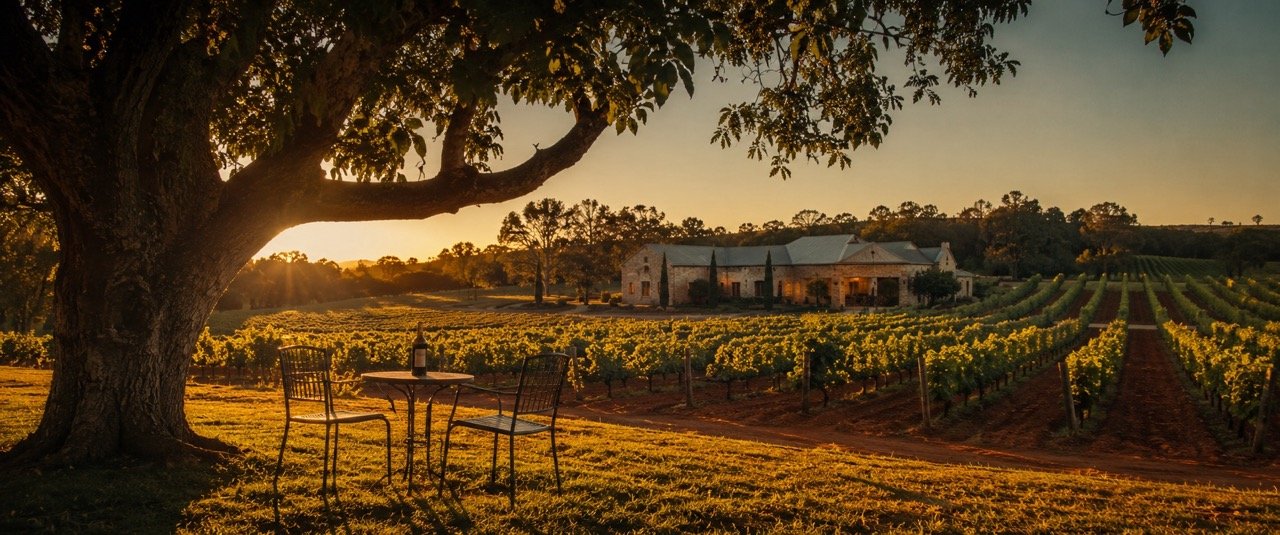
There is a version of the Yarra Valley that belongs to the weekend tripper: the cellar door converted from an old dairy, the cheese platter, the pinot that tastes reliably of cherries and forest floor. That version has its place. But there is another Yarra — one that requires knowing which side of the Divide you are standing on, which vineyard faces north-northeast and catches the late afternoon cool, which producer is fetching their fruit from red volcanic soils rather than the heavier grey loams of the valley floor. This second Yarra is what makes the region, arguably, the most compelling cool-climate wine territory in the country.
The Great Dividing Range splits the valley into two distinct climatic zones. The Lower Yarra — Coldstream, Yering, the flatter ground near Healesville — is warmer, more generous, the wines rounder and more immediately approachable. The Upper Yarra — Seville, Hoddles Creek, Gembrook — is emphatically cooler, the elevation climbing past 300 metres, the growing season significantly longer, the wines slower to give, longer in the glass. The distinction matters enormously when you are choosing what to open and when. Most people don’t make it. The producers who work the Upper Yarra exclusively understand they are making wines that won’t perform their best trick for three or four years after vintage. They make them anyway.
The Wurundjeri Woi Wurrung people have cared for these ridges and river valleys for tens of thousands of years. The vines are extraordinarily recent tenants. What they have revealed, in forty-odd years of serious winemaking, is that the country’s geology — the red volcanic soils of the upper elevations, the alluvial flats below, the constant interplay of maritime cool air from the south — produces wines of a transparency and precision that has no real precedent on this continent.
Giant Steps: The Sexton Vineyard
Phil Sexton planted his estate vineyard in Healesville in 1997 and called the resulting winery Giant Steps. The name referred to the John Coltrane composition — but it also described what Sexton was attempting to do with Yarra Valley fruit: push the regional conversation from generic to site-specific, from “cool climate” as a marketing phrase to something earned parcel by parcel. The winery sits on Maroondah Highway in Healesville, a long, intelligent building that functions as both production facility and one of the valley’s best lunch destinations.
The Sexton Vineyard Pinot Noir is the standard-bearer. The home block carries a collection of Dijon clones — 115, 667, 777 — planted across soils that vary enough within the single vineyard to produce meaningful internal complexity. Winemaker Steve Fletcher works with between 30 and 50 percent whole bunches depending on the vintage, and the approach shows: there is a structural lift to the Sexton that separates it from the riper, more extracted style that still afflicts parts of the valley. The 2021 has the kind of translucent cherry clarity that makes you think of Gevrey-Chambertin villages rather than anything overtly Southern Hemisphere. The fermentation is open-top, foot-trodden, and the wine spends thirteen months in tight-grained Burgundy oak before bottling. It is not trying to be Burgundy. It is finding its own register through the same disciplined restraint.
Giant Steps also produces single-vineyard Chardonnay from Tarraford, Primavera, and other contracted fruit sources across the valley floor. The Tarraford Chardonnay — from a Lower Yarra block at Coldstream — is crisply oxidative in the Raveneau manner, with gunflint and green apple giving way to something rounder by the third glass.
Maroondah Hwy, Healesville. giantstepswine.com.au
De Bortoli: Lusatia Park
The Lusatia Park Vineyard in Yering is one of the Yarra Valley’s most important pieces of real estate — and also one of its most quietly shared. The De Bortoli family planted it in the 1980s and it has become the source material for a number of the valley’s finest wines, both under the De Bortoli label itself and under Yarra Valley names that simply list it as a contracted vineyard. Giant Steps uses Lusatia Park Chardonnay fruit. The vineyard’s 18.7 hectares are planted predominantly to Chardonnay and Pinot Noir, and its elevation and aspect — facing north, with good elevation from the valley floor — gives the fruit an intensity that the flatter blocks cannot match.
Under winemaker Steve Webber, De Bortoli’s own Lusatia Park Chardonnay is the more intellectually serious of the two variety expressions from this site. Webber has been making Yarra Valley wine for over thirty years with a consistency that the more fashionable producers of the last decade have not yet matched. His Chardonnay is textural without heaviness, with a mineral grip on the finish that is entirely site-derived — it tastes of the place, which is the only test that matters. The Lusatia Park Pinot Noir is darker-fruited than the Giant Steps Sexton, more savouriness on the finish, more earth.
What Webber has always understood is that the Yarra Valley’s finest fruit demands restraint from the winemaker. The oak programme at De Bortoli is measured with a seriousness that many larger Australian producers abandoned in the 1990s. The wines are aged in a high proportion of older barrels, with minimal new oak in most vintages. When the fruit is right, you do not need to add wood flavour.
Pinnacle Lane, Dixons Creek. debortoli.com.au
Seville Estate: The Case for the Upper Yarra
Dr Peter McMahon planted the first vines at Seville Estate in 1972, which puts the property at the very beginning of the modern Yarra Valley wine story. The vineyard sits in the Upper Yarra, at elevation, on red volcanic soils — the kind of geology that produces wines of intensity and aromatic precision. That history matters: unlike many Yarra producers working younger vines, Seville Estate has Old Vine material that brings a concentration and structural complexity the more recent plantings simply cannot replicate.
The estate’s Pinot Noir employs whole bunch fermentation as a textural and aromatic tool rather than as a trend. Recent vintages use roughly 30 percent whole cluster fruit alongside 70 percent destemmed, giving the wine a stalky lift and a charcutier savouriness that cuts through the red fruit and keeps the palate alive. This is the Upper Yarra doing what it does best: producing wine that tastes of somewhere specific, that has an identifiable mineral signature, that becomes more interesting in the glass over an hour rather than less. The Reserve bottling, from the oldest vineyard blocks, shows what these soils can do with another three or four years of patience.
The property itself retains the character of the working farm — it is not a theatrical cellar door. The tasting room overlooks the old vines. This is a place where the Yarra Valley’s founding generation meets the conversation happening in the region’s contemporary winemaking, and it rewards the visit for that reason.
65 Linwood Rd, Seville. sevilleestate.com.au
Punt Road: The Napoleone Block and the Coldstream Argument
Punt Road is the Napoleone family’s label, and the Napoleone Block Pinot Noir is an argument for the Lower Yarra’s warmth as a feature rather than a limitation. The vineyard is at Coldstream, on heavier clay-loam soils, and the wine it produces has a depth and richness that is quite different from the cooler site expressions. It is more full-bodied, more immediately approachable in youth, with darker fruit — black cherry, plum skin — alongside the forest floor characters that define good Yarra Pinot.
Winemaker Kate Goodman works the vineyard intensively and the attention shows in the wine’s structure. This is not a soft, immediately likeable commercial Pinot — it has genuine tannin structure, genuine grip — but it is more approachable than an Upper Yarra expression at the same age. If you are opening Yarra Pinot without planning to cellar it, the Napoleone Block rewards you sooner. The Chardonnay from this estate, made from fruit on the same property, is one of the valley’s quieter achievements: restrained, almost tensile, with a length that belies its price.
The Punt Road property also functions as a guide to the Yarra Valley’s terroir conversation in the most direct way — because you can visit, taste across several vintages of the same vineyard expression, and understand for yourself how the warm 2017 compares to the cool 2021. Terroir, in the end, is a conversation between place and weather. Punt Road lets you hear both sides.
10 St Huberts Rd, Coldstream. puntroad.com.au
On Reading the Yarra Correctly
The valley’s wines demand a vocabulary that most Australian wine drinkers have been trained away from: not fruit-forward, not immediately expressive, not a single-register hit of something familiar. Reading the Yarra correctly means understanding which side of the Divide you are on, what the elevation is doing to the growing season, which soil type is under the vine.
A few protocols for the serious reader:
Ask about the vintage before anything else. The Yarra’s cool climate makes it genuinely vintage-sensitive in a way that warmer regions are not. A cool vintage like 2021 produces wines of translucent precision. A warm vintage like 2019 produces riper, more immediately approachable wines. Neither is wrong, but they are different conversations.
Upper Yarra for Pinot; either for Chardonnay. The Upper Yarra’s longer, cooler growing season gives Pinot Noir time to build structural complexity rather than just ripening sugar. Chardonnay performs beautifully across both zones, with the upper sites adding more tension and minerality.
The Yarra Valley is forty minutes from the city. This is not a wine region that demands a long-weekend commitment. The temptation is to treat it as a day trip. Resist that — the valley rewards deeper engagement, and the producers listed here are worth more than one visit.
Cellaring discipline separates the good drinker from the great one. The Yarra’s finest Pinots — the Sexton Vineyard, the Lusatia Park, the Seville Old Vine Reserve — are asking for four to seven years from vintage before they give everything they have. Drink them sooner and you will taste a very good wine. Wait and you will taste something that has no competition in the Southern Hemisphere.